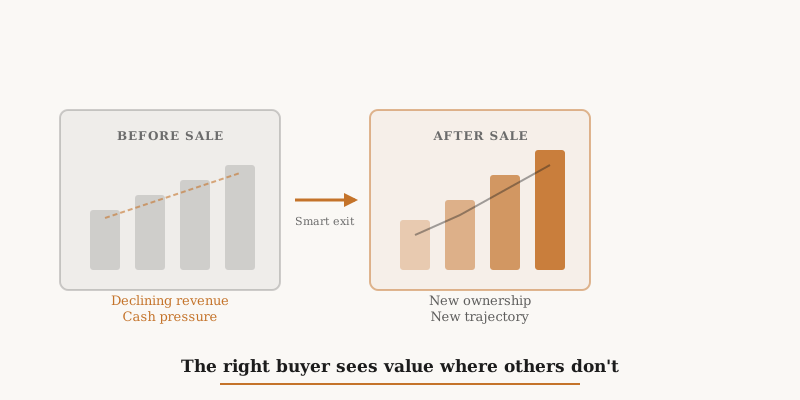
Selling a distressed business is often the best option because it lets you settle debts and liabilities before they compound, hand the business to an owner with the resources or expertise to turn it around, and protect your own finances and wellbeing when personal circumstances mean you can no longer invest in it. The sooner it's considered, the better the outcome tends to be, and for most owners it is a strategic, financially sound decision rather than a defeat.
For many business owners, the idea of selling a struggling business feels like defeat. But in reality, selling a distressed business is often the most strategic and financially sound decision available — and the sooner it’s considered, the better the outcome tends to be. Reasons to Consider Selling a Distressed Business Financial and liability concerns Businesses in distress often carry significant financial and legal burdens — unpaid debts, outstanding liabilities, and compliance issues that become harder and more expensive to manage over time. Selling allows owners to address these obligations, pay off creditors, and avoid the compounding damage of continued losses. Letting go early, before the situation deteriorates further, typically results in a better outcome for everyone involved. Lack of resources or expertise Sometimes the challenge isn’t the business itself — it’s that the current owner lacks the resources, capital, or operational expertise needed to turn things around. What feels like an impossible situation for one owner may be a straightforward opportunity for a buyer with the right background and financial firepower. Selling in this situation isn’t giving up. It’s recognising that another owner may be better placed to make the business succeed — and ensuring that the employees, customers, and assets are protected in the process. Personal reasons A change in personal circumstances — retirement, illness, burnout, or a desire to pursue other opportunities — is a legitimate and common reason to sell a distressed business. There’s no point continuing to invest time, money, and energy into something that no longer aligns with where you want to be. Selling allows for a clean break, relieves ongoing stress, and can protect your personal financial position before things get worse. How to Identify a Distressed Business A distressed business is one that is underperforming relative to its potential — this might be due to declining revenue, poor management, excessive debt, changing market conditions, or a combination of factors. If you’re asking whether a sale is possible in this situation, the answer is yes — read our guide on selling a failing business . Key warning signs include: Declining sales or shrinking market share Reduced profit margins or persistent losses Rising debt levels Loss of key customers or contracts High staff turnover Cash flow problems The earlier these signs are recognised, the more options remain available. A business that is struggling but still operating has considerably more value than one that has ceased trading. Preparing a Distressed Business for Sale Clean up finances and records Buyers of distressed businesses expect problems — but they still need to understand what they’re buying. Clean, organised financial records are essential. This means accurate income statements, balance sheets, and cash flow statements for at least the past two to three years. The cleaner and more transparent the financial picture, the easier it is to find a buyer and agree a fair price. Maximise value through restructuring or rebranding Even modest improvements can meaningfully increase the sale price. Streamlining operations, cutting unnecessary costs, renegotiating contracts, or refreshing the brand identity can all enhance the perceived and actual value of the business. Working with advisors who understand what buyers look for is invaluable here. Find the right buyer Not every buyer is right for every distressed business. The ideal buyer is one whose vision, capabilities, and resources align with what the business needs to succeed. A buyer who understands the sector, has a credible plan, and has the financial capacity to follow through is far more likely to complete the deal — and to protect the business and its people after the sale. Alternatives to Selling Selling isn’t the only option. Depending on the situation, it may be worth exploring: Restructuring — reorganising operations, reducing costs, and repositioning the business for a different market or customer base Outside investment — bringing in a strategic or financial partner to inject capital and expertise Orderly wind-down — in some cases, a managed closure is preferable to a fire sale Each option has genuine merit depending on the circumstances. The key is to make a decision based on honest assessment rather than wishful thinking. Conclusion Selling a distressed business is not failure. In many cases, it is the most responsible, financially sound, and practically sensible decision available. The worst outcome is usually inaction — continuing to pour resources into a situation that is not improving while options narrow. If your business is under pressure, the time to explore your options is now — not when you’ve run out of them. Get in touch with us today for a confidential, no-obligation conversation. Ready to explore your options? We're direct acquirers — no broker fees, total confidentiality, and no obligation to proceed. Start a Confidential ConversationReady to explore your options?
We're direct acquirers — no broker fees, total confidentiality, and no obligation to proceed.
Start a Confidential Conversation