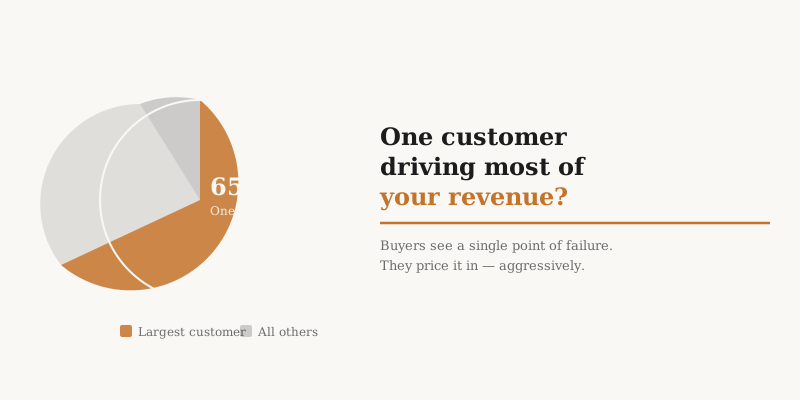
Customer concentration depresses your valuation because buyers price in the risk of losing your biggest customer. The industry benchmark is roughly 15 to 20% of revenue in a single customer; above that, most buyers discount your multiple by 20 to 30%, or hold back part of the price until the relationship proves stable under new ownership. On a business with £300,000 of EBITDA, the difference between a 5x and a 3.5x multiple is £450,000, the real cost of concentration risk that only becomes visible once a buyer runs the numbers.
Most business owners know, in the abstract, that having too much revenue concentrated in one or two customers is not ideal. What very few of them know is exactly how much it costs when they come to sell. The answer, when the numbers become visible, tends to surprise people. What Buyers See When a buyer reviews your accounts during due diligence, one of the first things they will do is break down revenue by customer. They want to know: if your top customer left tomorrow, what would happen to this business? The industry benchmark is roughly 15–20%. If a single customer accounts for more than that proportion of revenue, most experienced buyers will flag it as a concentration risk. The more concentrated the revenue — 30%, 40%, 50% or more in a single relationship — the more aggressively it is priced into the deal. How it shows up varies by buyer and deal structure. Sometimes it is a reduction in the multiple applied to earnings. Sometimes it is a request for a retention mechanism — an escrow held back until the key customer has demonstrated continued loyalty under the new owner. Sometimes it is a conditional earn-out, where part of the price is only paid if the customer is still in place twelve or twenty-four months after completion. And sometimes the buyer simply decides the risk is too large to accept and withdraws. Why It Is So Common Customer concentration is not a sign of a poorly run business. It is often the opposite. Many concentrated customer relationships are the result of doing excellent work for an important client over a long period of time. The client grew. The relationship deepened. Their spend increased. The business that served them grew alongside them. The problem is structural, not operational. A business that has one customer representing 40% of revenue may be commercially excellent. But from a buyer’s perspective, it is a business with a fundamental vulnerability — a single point of failure that could unwind a significant portion of the value they are acquiring. The other reason it is common is that growing a business is hard enough without actively managing the distribution of that growth. Owners who are focused on delivery, on quality, on growing revenue — which is exactly what they should be focused on — are not naturally inclined to turn away business from a good customer in order to maintain an abstract portfolio balance. The concentration often creeps up gradually, and the owner notices it as a problem only when they start thinking about selling. The Real Cost To understand the financial impact, consider two businesses that are identical in every respect — same turnover, same profit, same sector, same management team — except that Business A has its revenue spread across 40 customers, no single one above 10%, while Business B has one customer at 45% and the remainder distributed among 15 others. A typical SME in a stable sector might attract a multiple of 4–5x EBITDA. Business A, with its diversified revenue, is straightforwardly valued at that range. Business B, with its concentration risk, might attract a discount of 20–30% on the multiple — or require a retention mechanism that defers a portion of the price, sometimes with conditions attached. On a business with £300,000 of EBITDA, the difference between a 5x and a 3.5x multiple is £450,000. That is the cost of the concentration risk, sitting right there in the gap between the two numbers. What You Can Do About It The good news is that customer concentration is fixable. The less good news is that it takes time — which is another reason why starting your exit planning early matters more than most owners realise. Actively pursue new customers in different segments or verticals. This sounds obvious, but it requires deliberately prioritising growth outside your existing strong relationships, even when the path of least resistance is to do more for the clients you already have. A marketing and new business investment in the two to three years before a sale can meaningfully shift the revenue distribution. Do not turn work away from existing large customers, but structure it carefully. Reducing a major client’s revenue contribution is not about reducing their business — it is about growing everything else faster. The target is to grow the overall base so that any single client represents a smaller proportion, not to shrink the strongest relationships. Get contracts in place. A concentrated customer relationship is far less alarming to a buyer if it is underpinned by a long-term, signed contract. If your largest customer is on a three-year agreement with clear renewal terms, a buyer has some protection against the risk of them leaving. A handshake relationship or rolling monthly contract with a customer at 40% of revenue is a much harder sell. Be transparent and proactive. If concentration is a feature of your business when you go to market, name it early, explain the relationship, and provide context that helps the buyer assess the actual risk. A loyal customer of fifteen years who has never missed a payment and who has signed a new contract is a very different risk profile from a large customer acquired recently on undocumented terms. Buyers can distinguish between the two — but they need the information to do so. When You Cannot Fix It Before the Sale Sometimes the timeline does not allow for a full restructuring of the customer base. An owner who needs to exit within twelve months does not have the runway to move a 45% customer to 15%. In that situation, the most important thing is honesty. Know the number, understand what it is likely to cost in terms of deal structure or price, and go into the process with clear eyes. Buyers who discover concentration risk that was not disclosed will react very differently from those who were told about it upfront. An experienced acquirer — particularly one who has bought businesses in your sector — will have seen concentration risk before. They will have views on how to manage the customer transition and how to structure the deal to reflect the risk fairly. That is a much better conversation to have than the one that happens when the buyer finds the number themselves in due diligence. If you want to understand exactly where your business stands on this and what it might mean for your exit, get in touch . It is the kind of specific, practical question we are well-placed to answer. Ready to explore your options? We're direct acquirers — no broker fees, total confidentiality, and no obligation to proceed. Start a Confidential ConversationReady to explore your options?
We're direct acquirers — no broker fees, total confidentiality, and no obligation to proceed.
Start a Confidential Conversation