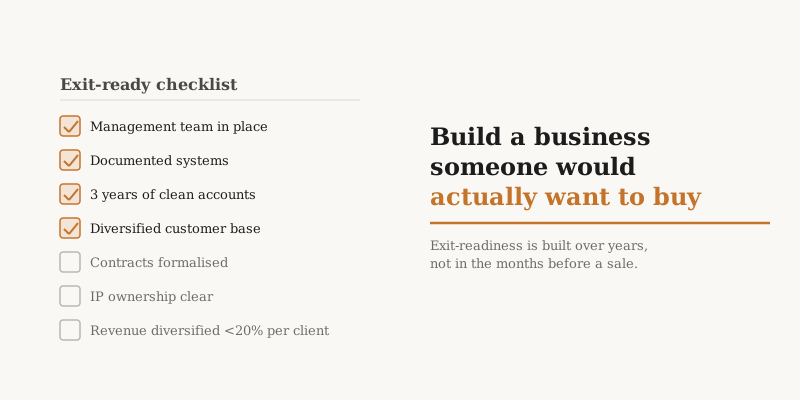
Most business owners could not sell their business tomorrow, even at a fair price, not because it isn't a good business but because it hasn't been built with transferability in mind. Building one that someone would actually want to buy means separating yourself from day-to-day operations, documenting systems so the business runs without your personal knowledge, keeping clean and consistent finances, diversifying revenue so no single customer represents more than 15-20% of income, and putting key relationships into signed contracts.
That is fixable. Here is how.
There is a useful thought experiment for any business owner, regardless of whether they are thinking about selling: if a credible buyer appeared tomorrow and offered you a fair price, could you sell? Not “would you want to” — that is a different question. Could you? Do the accounts tell a clear story? Is the management team capable of running the business without you? Do your customer relationships survive the change of ownership? Are the contracts in place? For most owners, the honest answer is no — not because the business is not good, but because it has not been built with transferability in mind. That is fixable. Here is how. Separate Yourself From the Business This is the foundation of everything else. A business whose value is tied to the personal relationships, technical skills, or daily presence of its owner is not yet a business in the sense that a buyer needs it to be. It is a practice — dependent on the practitioner. The process of separating yourself from the business operationally is both the hardest and most valuable thing you can do before a sale. It involves building a team that can make decisions without you, creating processes that do not depend on your knowledge, and — most uncomfortably — letting things be done less perfectly than you would do them in exchange for the business becoming genuinely independent. The four stages of business ownership sets out what this looks like in practice. Moving from Stage Two (owner still essential) to Stage Three (management team in place) is where most of the value is created. Getting to Stage Four — where the owner is board-level only — commands the premium valuations. Both transitions take years, not months. Build Systems, Not Habits Much of what makes a small business run well is stored in the heads of the people who have been there from the beginning. The owner knows which supplier to call when the usual one cannot deliver. The long-serving office manager knows how to handle the difficult customer. The senior salesperson knows which leads are worth pursuing and which are not. None of that knowledge exists in any form that a new owner can access. When those people leave — and a sale often prompts exactly that — the knowledge leaves with them. Documented systems are the antidote. Standard operating procedures, process maps, supplier guides, customer relationship records, sales playbooks — all of these transform tacit knowledge into institutional knowledge. They make the business legible to a buyer. They also make it easier to onboard new staff, reduce errors, and maintain consistency as the business grows. The test: could someone competent, but entirely new to your business, follow your documentation and run the operation at 80% effectiveness within ninety days? If not, the documentation needs work. Clean Up the Finances — And Keep Them Clean Buyers will look at a minimum of three years of accounts. What they want to see is a consistent, clean, explicable financial record. What they do not want to find — and what will either reduce their offer or derail the process entirely — are records that require lengthy explanation, contain unexplained anomalies, or mix personal and business finances in ways that make the true profitability of the business unclear. The practical steps are straightforward, even if not always convenient. Keep personal expenses out of the business accounts, or if they are in there, document them clearly so they can be added back in any valuation. Ensure revenue is recognised consistently. Resolve any outstanding tax issues. Make sure the business is filing its statutory accounts correctly and on time. The goal is not accounts that tell a flattering story — it is accounts that tell a clear and accurate one. Buyers who trust the numbers make better offers than buyers who do not. Diversify Your Revenue As we explore in more detail in our article on customer concentration , a business where one or two customers represent a large proportion of revenue is a business with a valuation problem. The revenue may be real and may have been stable for years — but a buyer sees a single point of failure, and they price that risk in. Building a diversified revenue base takes time. It requires investing in new business development even when the existing customer relationships are performing well. It requires the discipline to grow the base rather than simply deepening the existing relationships. The target is a customer distribution where no single customer represents more than 15–20% of revenue. If you are significantly above that with your largest account, start now — the gap between where you are and where you need to be will take years to close through organic growth. Get Contracts in Place This is one of the most overlooked areas of exit preparation, and one of the most impactful. Customer relationships that exist on handshakes, emails, or rolling monthly arrangements are worth less to a buyer than relationships that are underpinned by signed agreements. Not because the handshake customers are more likely to leave — in fact, some of the most loyal customers have never signed a formal contract — but because the buyer has no legal claim on revenue that is not contractually committed. The same applies to supplier arrangements, distribution rights, intellectual property ownership, and any other agreements that are critical to how the business operates. If a key supply arrangement exists in an email thread, get it into a contract. If software or creative work was developed by a contractor without a clear IP assignment clause, address it. If a key employee’s terms of employment are not up to date, fix it. None of these are difficult to do. But they take time, and they are much easier to address in a low-pressure environment than in the middle of a sale process. Know What You Are Building Towards All of the above is more effective with a destination in mind. Owners who set themselves a concrete target — “I want to be in a position to sell in three to four years, at a price that funds my retirement and protects my team” — make better decisions than those who think vaguely about an exit at some point in the future. The specificity matters because it changes how you prioritise. When you know what a buyer will need to see, and you know you have three years to create it, every decision about where to invest time and capital becomes clearer. That does not require committing to a sale. It requires committing to building a business that could sell — which, as it happens, is also a business that is more valuable, more resilient, and more satisfying to own. If you would like an honest view of where your business stands against these criteria and what a realistic exit might look like from here, get in touch . We look at businesses at every stage and can tell you clearly what we see. Ready to explore your options? We're direct acquirers — no broker fees, total confidentiality, and no obligation to proceed. Start a Confidential ConversationReady to explore your options?
We're direct acquirers — no broker fees, total confidentiality, and no obligation to proceed.
Start a Confidential Conversation