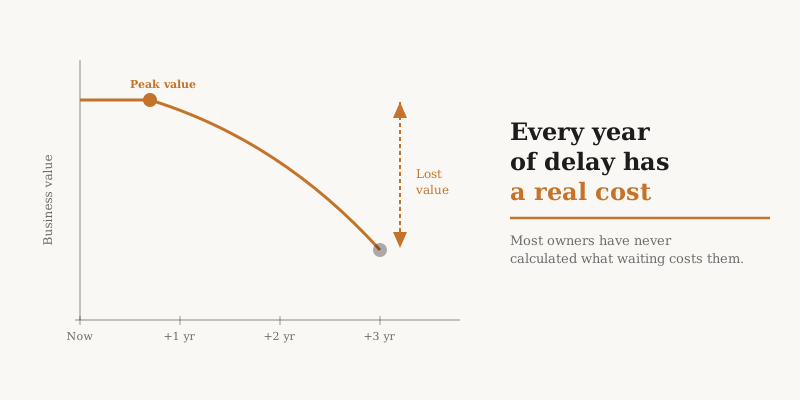
Waiting too long to sell has a real cost. On a £2 million business, a two year delay can mean roughly £200,000 in lost investment returns alone, before you even factor in the business losing value in a market that has moved on or the owner losing the leverage to negotiate a good price.
This is not an argument for selling before you are ready. There are good reasons to wait, such as the business still growing or a particular milestone within reach, and timing a sale well is a legitimate part of exit planning. But there is a difference between waiting strategically and waiting by default: continuing to defer a decision because the present situation is tolerable, without a clear sense of when or why the timing will become better. The second kind of waiting is where the real cost accumulates.
Every business owner who is thinking about selling but has not yet started the process is making a decision — they just may not realise they are making it. The decision to wait is not a neutral act. It has costs, and those costs compound quietly over time in ways that often do not become visible until they are very difficult to reverse. This is not an argument for selling before you are ready. There are good reasons to wait: the business is still growing, a particular milestone is within reach, personal circumstances make the timing wrong. Timing a sale well is a legitimate part of exit planning, and rushing into a sale from a position of weakness rarely ends well. But there is a difference between waiting strategically and waiting by default — continuing to defer a decision because the present situation is tolerable, without a clear sense of when or why the timing will become better. The second kind of waiting is where the real cost accumulates. The Business May Not Stay at Its Peak A business is not a static asset that holds its value while the owner waits. It changes — and not always in a positive direction. Market conditions shift. A sector that was growing strongly may plateau or contract. Competitors emerge. Technology disrupts established business models. Customer relationships, however loyal, are not permanent. The business that was worth £2 million in 2022 may be worth substantially less in 2027 if the market it operates in has moved against it. The owner who sold at the right moment — when the business was performing well and the sector was buoyant — achieved a price that reflected the business at its best. The owner who waited too long sold into a market that had moved on. This is not inevitable, of course. Businesses can grow and improve over time, and the right preparation can increase value significantly. But the assumption that a business will be worth at least as much in three years as it is today is not always correct. Markets are not static. Neither are businesses. The Owner’s Capacity Changes Business ownership is physically and mentally demanding. The capacity to sustain that demand changes over time. Many owners reach a point where the energy required to run the business at the level it deserves — managing a team, maintaining customer relationships, driving growth, handling the inevitable crises — starts to feel disproportionate to the returns. That is not a failure of character or commitment. It is a human reality. The problem is that when an owner’s energy drops, the business feels it. Quality of management decisions declines. Growth slows. Staff sense the change and some begin to look elsewhere. The business that was a high-performing, growing enterprise gradually becomes one that is well-run but stuck. By the time the owner has acknowledged to themselves that they need to exit, the business may have lost some of the vitality and momentum that attracted buyers. The exit that would have been straightforward two years earlier becomes more complicated. Options Narrow as Time Passes The more acute the need to exit, the fewer options an owner has. An owner who begins the exit process from a position of strength — no immediate pressure, good performance, a business at or near its peak — can afford to be selective. They can run a proper process, engage with multiple buyers, wait for the right fit, and decline an offer that does not meet their expectations. An owner who needs to exit quickly — because of declining health, business stress, cash flow pressure, or a personal situation that demands resolution — has much less leverage. Buyers can sense urgency, and they price it in. The seller who needs to complete by a fixed date is a seller whose negotiating position is significantly weakened. This is why the common advice about not selling from a position of weakness is right — but the implication that many advisers leave unstated is that the time to ensure you are not in a position of weakness is years before the exit, not weeks before. The Financial Cost of Deferred Proceeds There is a simple financial calculation that rarely gets made explicit. Every year that the sale is deferred is a year that the proceeds of the sale are not in the owner’s hands, not invested, not generating a return, and not available for whatever the owner plans to do with them. On a £2 million business, a two-year delay in completing the sale — assuming the value stays flat — represents approximately £200,000 in lost investment returns at a conservative 5% annual yield. If the business value declines during those two years, the cost is larger still. This does not mean that every owner should sell immediately. But it means that the cost of waiting has a number attached to it — and most owners have never calculated it. What a Good Timeline Looks Like The owners who achieve the best exits typically start the process two to three years before they want to complete. That runway allows them to address the things that buyers most commonly find concerning in due diligence , build or strengthen the management team, improve the financial record, and enter the market from a position of choice rather than necessity. They also tend to be the owners who have the most options when it comes to who they sell to and how the deal is structured. Starting early creates optionality. Waiting until the need is urgent removes it. If you are at the stage where you are beginning to think about selling — even if you feel it is years away — the most valuable thing you can do is start understanding your options now. Get in touch for an honest, no-obligation conversation about where your business is today and what a realistic exit looks like from here. Ready to explore your options? We're direct acquirers — no broker fees, total confidentiality, and no obligation to proceed. Start a Confidential ConversationReady to explore your options?
We're direct acquirers — no broker fees, total confidentiality, and no obligation to proceed.
Start a Confidential Conversation