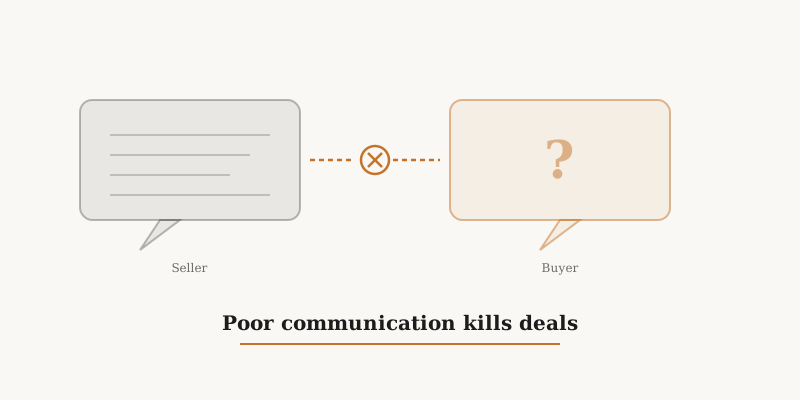
Poor communication stops business owners from selling because it leaves buyers to fill in the gaps themselves, and buyers who fill in gaps tend to assume the worst: fluctuating revenue reads as customer concentration risk, an owner who is central to everything reads as a business that cannot function without them. In a significant proportion of failed deals, the real cause isn't a low offer or a buyer's cold feet; it's the seller failing to communicate clearly, withhold nothing that matters, and manage the process consistently.
This doesn't mean dishonesty or deliberate misdirection, though those certainly kill deals too. It means failing to understand what the buyer actually needs to know, and failing to manage the conversation in a way that builds trust rather than erodes it. Here's how poor communication derails business sales, and what to do instead.
Most business owners, when a sale falls through, blame the buyer. The offer wasn’t high enough. The buyer got cold feet. The due diligence was unreasonable. But in a significant proportion of failed deals, the real cause is closer to home: poor communication from the seller. This doesn’t mean dishonesty or deliberate misdirection — though those certainly kill deals too. It means failing to communicate clearly, failing to understand what the buyer actually needs to know, and failing to manage the conversation in a way that builds trust rather than erodes it. Here’s how poor communication derails business sales — and what to do instead. Misunderstanding What Buyers Actually Need A business owner who has run their company for fifteen years knows it intimately. They know which customers are loyal, which staff are excellent, which contracts are solid, and which parts of the business need attention. The problem is that buyers don’t have that knowledge — and sellers often forget this. Sellers who don’t communicate the business clearly leave buyers to fill in the gaps themselves. Buyers filling in gaps tend to assume the worst. They see revenue that fluctuates month to month and assume customer concentration risk. They see an owner who is central to everything and assume the business can’t operate without them. They see two years of flat profit and assume the business is in decline. Effective communication means anticipating what a buyer will want to understand and providing that context proactively — not waiting to be asked. What this looks like in practice: Prepare a brief document (an information memorandum) that explains the business, its history, its customer base, its team, and its financial performance in terms a buyer can assess Explain the story behind any unusual numbers — a one-off bad year, a large capital expenditure, a customer lost and replaced with two better ones Be clear about what you’re looking for: a clean exit, a partial sale, an earn-out, or involvement in a transition period The Trust Gap: What You Don’t Say Matters as Much as What You Do Transparency is the single biggest driver of trust in a business sale. Buyers know that sellers are presenting their business in the best possible light — that’s expected. What they’re looking for is evidence that the seller is being honest about the things that aren’t perfect. A business owner who volunteers a known weakness — a key customer who represents 30% of revenue, a lease that expires in 18 months, a margin that has been under pressure — signals integrity. It tells the buyer: this seller is not hiding things. That signal is enormously valuable. By contrast, a seller who withholds information — intentionally or simply by not thinking to mention it — creates a problem the moment the buyer discovers it in due diligence. At that point, trust collapses. The buyer now wonders what else they don’t know. Deals that were progressing smoothly come apart. Real example: A manufacturing business owner was selling his company and hadn’t mentioned that one of his key machines was due for significant maintenance within the year. The buyer discovered this during a site visit. The result wasn’t just a renegotiation on price — it was a complete breakdown of confidence that took weeks to repair and ultimately resulted in a lower price than would have been achieved if the issue had been raised openly at the outset. Negotiation: Clarity, Not Stubbornness Many sellers approach negotiation as though it’s a battle — concede nothing, hold the line, push back on everything. This approach, while understandable, is usually counterproductive. Effective negotiation in a business sale is more about clear communication of your priorities than about winning every point. If you know that the headline price matters more to you than the payment structure, say so — and be genuinely flexible on the payment structure. If you need a clean break and don’t want to be tied in for two years, communicate that early, before it becomes a sticking point. Buyers who understand what matters to a seller can structure deals accordingly. Deals that work for both sides complete. Deals where one side is stonewalling don’t. Common communication failures in negotiation: Refusing to explain the rationale behind your asking price — this reads as either ignorance or bluster Reacting emotionally to a low offer rather than responding with clear reasoning Leaving key terms (earn-out conditions, handover period, warranties) vague until late in the process, when disagreement derails an otherwise agreed deal Failing to communicate with your own advisers clearly, leading to mixed messages reaching the buyer Managing the Process: Consistency Matters A sale process that goes quiet for weeks, produces contradictory information from different parties, or where the seller seems uncertain about their own position creates anxiety in buyers. Anxious buyers don’t complete deals — they find reasons to walk away or renegotiate. Consistent, reliable communication throughout the process — prompt responses to questions, clear timelines, and honest updates on any complications — builds the confidence buyers need to commit. This is one reason why working with experienced advisers, or directly with an acquirer who has been through the process many times, helps. An experienced buyer knows how to keep a process moving and how to handle complications calmly — which takes pressure off the seller. The Practical Checklist If you’re preparing to sell your business, here are the communication basics that make the biggest difference: Prepare your numbers — know your last three years of accounts, your current run-rate revenue, your customer concentration, and your key costs. Be able to explain all of them. Identify your weaknesses before the buyer does — and have a clear, honest explanation ready for each one Decide your priorities — price, speed, deal structure, staff protection, your own ongoing involvement — and be clear about them early Respond promptly — delays in responding to buyer queries signal disorganisation at best and evasiveness at worst Keep advisers aligned — make sure your accountant, lawyer, and any other advisers are all working from the same brief Conclusion The businesses that sell successfully are not always the best businesses. They are the businesses where the owner communicates clearly, builds trust with the buyer, and manages the process without letting emotion get in the way. Poor communication doesn’t just slow deals down — it kills them. And in a market where 80% of businesses that come to market never sell , the margin for error is small. If you’d like to talk through how a direct sale process with Oceanus Group works — and why removing the communication complexity of brokers and multiple parties often leads to better outcomes — get in touch . Ready to explore your options? We're direct acquirers — no broker fees, total confidentiality, and no obligation to proceed. Start a Confidential ConversationReady to explore your options?
We're direct acquirers — no broker fees, total confidentiality, and no obligation to proceed.
Start a Confidential Conversation