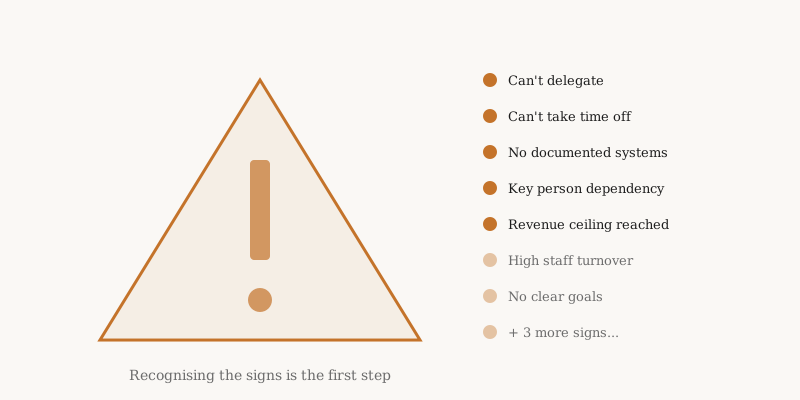
Your business has become a glorified job the moment it can't run without your daily input — if you can't delegate, can't take a proper holiday, or the whole operation grinds to a halt the day you step away. That's the critical difference between owning a business and being employed by one you happen to own: the former gives you leverage, freedom and the ability to step away, while the latter traps you with no easy way out. Below are 10 warning signs your business has crossed that line, and why recognising them early matters.
There’s a critical difference between owning a business and being employed by one you happen to own. The former gives you leverage, freedom, and the ability to step away. The latter traps you — reliant on your own daily input to keep things running, with no easy way out. Here are 10 warning signs that your business has become a glorified job — and why recognising them early matters. 1. You Can’t Delegate If every significant task either gets done by you or gets done wrong, that’s a warning sign. Inability to delegate effectively means the business is built around your personal involvement rather than around systems and capable people. This leads to burnout, limits growth, and makes your business extremely difficult to sell — because a buyer is effectively buying you, not a business. It’s one of the most common reasons businesses fail to sell . The fix: invest in building a team with the skills and authority to make decisions without you. 2. You Can’t Take Time Off A business that falls apart when you’re on holiday is not a business — it’s a dependency. If your phone doesn’t stop when you’re away, if decisions wait for your return, if things go wrong without your daily presence, the business has no standalone value. Buyers don’t pay premium prices for businesses that require the seller to stay indefinitely. 3. No Digitalisation in Operations Businesses that haven’t adopted modern tools — for communication, operations, data, or customer management — are operating at a disadvantage and often don’t know it. The gap between digitised competitors and those still running on spreadsheets and manual processes widens every year. Not embracing digital tools is a warning sign of a business that hasn’t adapted and may not be capable of it. 4. No Systems or Processes If how things get done is stored in people’s heads — particularly yours — rather than in documented procedures, the business is fragile. There’s no consistency, no scalability, and no way to train new people effectively. Standard operating procedures aren’t just administrative overhead. They’re what allow a business to run, grow, and be handed over to someone else. 5. Over-Reliance on Key Personnel Any business where a single person — including you — is indispensable is a business with a serious vulnerability. When that person leaves, things break. This is true whether it’s the founder, a key salesperson, or the one person who knows how the accounting system works. Resilient businesses distribute knowledge and responsibility. They can survive the loss of any individual. 6. Inability to Scale If your business has hit a ceiling — the same revenue for several years, no ability to take on more customers without breaking the operation — that’s a problem that compounds over time. A business that can’t grow becomes less valuable year on year as its market position erodes. Scaling requires systems, capital, and people. If any of those are missing, growth will remain elusive. 7. Difficulty Finding and Retaining Talent High staff turnover, difficulty attracting good candidates, and losing good people to competitors are all warning signs. They suggest either that the business isn’t a compelling place to work, that compensation isn’t competitive, or that there’s no clear path for development. Good people want to work in a business with a future. A business that feels like a grind won’t attract or keep them. 8. No Clear Goals A business without defined, communicated goals operates reactively. Teams don’t know what they’re working towards. Decisions are made on instinct rather than strategy. Resources go where the noise is loudest rather than where the opportunity is greatest. Clear, specific, measurable goals — shared with the team and reviewed regularly — are the difference between a business with direction and one that drifts. 9. Inefficient Use of Time and Resources If the business regularly misses deadlines, spends disproportionate time on low-value activities, or has team members who are unclear on priorities, there are systemic inefficiencies that hold back both growth and profitability. Identifying and addressing these inefficiencies — often through better process design, better technology, or clearer accountability — can have a significant impact on both performance and value. 10. Failure to Adapt and Innovate Markets change. Customer expectations evolve. New competitors emerge. Businesses that don’t monitor these changes and respond appropriately find that what worked last year works less well this year — and may not work at all in five years’ time. A business that hasn’t changed significantly in several years should ask whether that’s because it’s found a stable, defensible position — or because it’s stopped looking up. What to Do If You Recognise These Signs Recognising that your business has become a job is the first step. The second is deciding what to do about it. Some owners will invest in addressing these issues — building team capability, implementing systems, developing a proper management structure — so that the business can eventually operate and grow independently. Done well, this dramatically increases the value of the business and makes a future exit far more achievable. Others will decide that the time and investment required to make those changes isn’t what they want to commit to at this stage of their life — and that the right move is to find a buyer now. Both are legitimate choices. What’s not useful is ignoring the warning signs and hoping things will improve on their own. If you’d like to talk through your options in confidence, get in touch — there’s no obligation and no broker fees involved. Ready to explore your options? We're direct acquirers — no broker fees, total confidentiality, and no obligation to proceed. Start a Confidential ConversationReady to explore your options?
We're direct acquirers — no broker fees, total confidentiality, and no obligation to proceed.
Start a Confidential Conversation