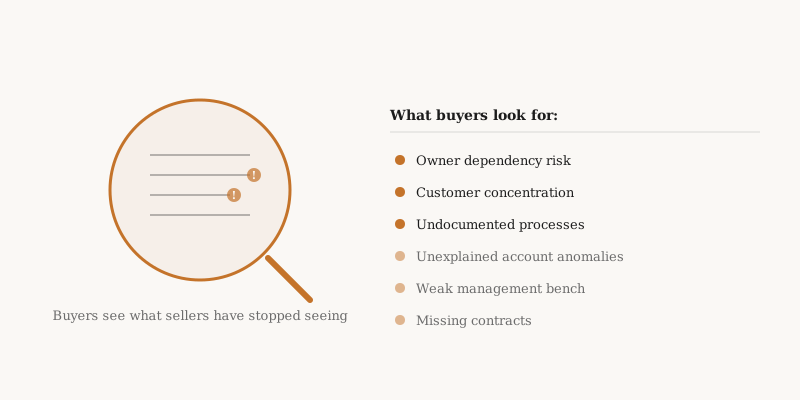
Buyers doing due diligence on a business focus on five things sellers rarely think to check: how concentrated the revenue is, whether customer relationships are properly documented, whether the financial records tell a consistent story, how dependent the business is on the owner, and whether there are legal or compliance gaps waiting to surface. A business turning over £2 million looks solid until a buyer notices that £800,000 of it comes from one customer on a rolling monthly contract, at which point the picture changes completely.
The gap between those two views is where deals collapse. Most of what follows is fixable, but knowing what a buyer is looking for is the first step to making sure they find what they hope to find.
Every business looks different depending on which side of the transaction you are standing on. The seller sees fifteen years of effort, a loyal team, customers who have stayed for a decade, and a business that still turns up every day and does what it promises. The buyer sees the accounts, the contracts, the dependencies, and the risks — and they are trained to find the things that the seller has either not noticed or not thought to mention. The gap between those two views is where deals collapse. What follows is a buyer’s-eye view of the due diligence red flags that most commonly cause problems. Not to alarm you — most of these are fixable — but because knowing what a buyer is looking for is the first step to making sure they find what they hope to find. Revenue That Is More Fragile Than It Looks A business turning over £2 million sounds like a solid business. But if £800,000 of that comes from one customer who has been on a rolling monthly contract for three years, a buyer sees something very different: a business whose revenue could collapse overnight if that relationship ends. Customer concentration is the single most common due diligence red flag in SME acquisitions. The general rule of thumb is that no single customer should represent more than 15–20% of revenue. When a customer represents 30%, 40%, or more, buyers will either price that risk into their offer or walk away. The same applies to supplier concentration. A business that relies on one or two suppliers for critical inputs is exposed to disruption in ways that go beyond what the profit and loss statement reveals. Contracts That Are Not Actually Contracts In a surprising number of small businesses, what the owner describes as a “long-term customer relationship” turns out, on closer inspection, to be an arrangement that has never been formally documented. Customers who have bought consistently for ten years but have no written agreement in place. Service arrangements that rely on a handshake and mutual goodwill. Distribution rights that exist in email threads rather than signed documents. Buyers are acquiring future cash flows. If those cash flows are not underpinned by enforceable agreements, the buyer has no legal claim on them. Every undocumented relationship is a risk that needs to be priced in. Related: contracts that are tied to the owner personally. Some customer relationships — particularly in professional services, consultancy, and trades — are structured around the founder rather than the company. When the owner leaves, those contracts may not automatically transfer. In some cases they explicitly terminate on change of control. Financial Records That Do Not Tell a Clean Story Buyers will want at least three years of accounts, and they will look at them carefully. What they are looking for is not perfection — most small businesses have something in the numbers that needs explaining — but clarity and consistency. What creates problems is when the numbers cannot be explained, are inconsistent between years in ways that suggest manipulation, or show a pattern the seller has not anticipated the buyer noticing. Common examples include: Owner expenses run through the business. This is extremely common in owner-managed businesses and is not, in itself, disqualifying. But it needs to be transparently disclosed and quantified. Buyers adjust for it — it is called “addback” — but only when they know about it. If they discover it themselves, trust evaporates. Revenue recognised inconsistently. Recognising revenue at different points in the delivery cycle from year to year makes year-on-year comparisons meaningless. It also suggests, whether fairly or not, that the numbers have been managed. Significant one-off items not clearly explained. A bad year, a large one-off cost, a customer lost and replaced — all of these are legitimate. But they need to be explained proactively. A buyer who finds something in the numbers and has to ask about it is a buyer whose confidence in the process has already taken a hit. Key Person Risk If the business requires you to function — if you hold the relationships, carry the technical knowledge, or are the primary reason customers stay — a buyer faces a problem that goes beyond the transition period. They are buying a business whose value is partly locked in a person who is about to leave. This manifests in several ways during due diligence. Which staff members hold relationships with the top ten customers? What happens if a key salesperson leaves? Is there a management team that could run the business, or does it revert to chaos when the owner is absent? The four stages of business ownership explains how buyers assess owner dependency structurally. A business at Stage One or Two faces much more scrutiny on this question than one at Stage Three or Four. Legal and Compliance Issues Buyers conduct searches and legal reviews that will surface things many sellers are surprised to discover. Employment disputes — even informal ones that were settled without formal proceedings — that were never properly documented. IP that was developed by a contractor rather than an employee, meaning it may not be owned by the company. Regulatory registrations that have lapsed or were never in place. Environmental obligations attached to a leased property. None of these are automatically deal-killers. Most can be managed if they are disclosed early and handled transparently. What turns them into deal-killers is when a buyer discovers them independently, at a late stage, after trust has been built on an incomplete picture. The Pattern Underneath All of This The common thread in every due diligence red flag is the gap between how the business looks from the inside and how it will look to someone examining it systematically from the outside. Most business owners are not hiding things. They simply have not examined their own business through a buyer’s lens. The contracts that feel solid because the relationships are good. The revenue that feels secure because the customer has been there for years. The financial records that make sense to the owner because they know the context. The practical implication is this: if you are thinking about selling — even years from now — it is worth commissioning a review of your business from the outside before you go to market. An experienced acquirer, a good accountant, or a legal adviser with M&A experience can identify the things that will cause friction before they cause it in front of a buyer. If you would like that kind of honest conversation about where your business stands, get in touch . We have looked at a lot of businesses and we can tell you straightforwardly what we see. Ready to explore your options? We're direct acquirers — no broker fees, total confidentiality, and no obligation to proceed. Start a Confidential ConversationReady to explore your options?
We're direct acquirers — no broker fees, total confidentiality, and no obligation to proceed.
Start a Confidential Conversation