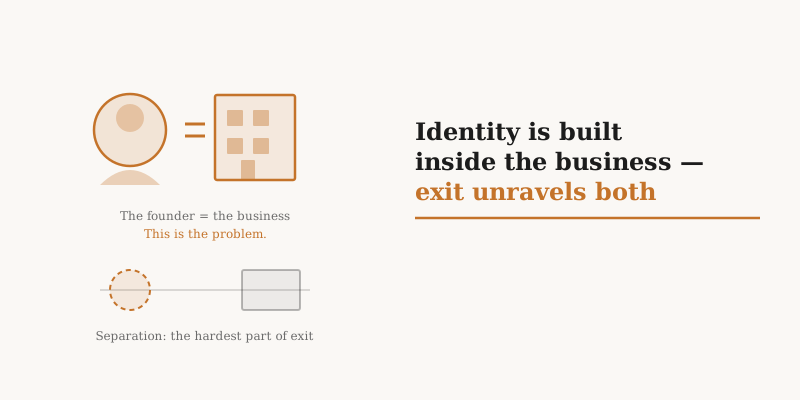
Some business owners stall deals that are clearly in their financial interest, agree to terms that make little sense, or simply decide, even after years of exhaustion and diminishing returns, that they are not ready to sell. It is rarely the valuation, the structure, the earn-out or the warranties holding them back. The real obstacle appears the morning after completion, when the owner wakes up with no idea who they are without the business they built.
Advisers write about the financial negotiation. Brokers negotiate over it. In the language of the industry, that is "the deal". But ask anyone who has sold a business they built from nothing, and they will say the deal was not the hardest part. This is the conversation the industry almost never has.
The financial negotiation is the part that gets all the attention. The valuation, the structure, the earn-out, the warranties. Advisers write about these things. Brokers negotiate over them. They are, in the language of the industry, the deal. But ask anyone who has been through the sale of a business they built from nothing, and they will tell you that the financial negotiation was not the hardest part. The hardest part was the morning after completion, when they woke up and had no idea who they were. This is the conversation the industry almost never has. And it is the reason some owners stall deals that are clearly in their financial interest, accept terms that make little sense, or simply decide — even in the face of exhaustion and diminishing returns — that they are not ready. Not because the deal is wrong. Because they are not ready to stop being the person who owns the business. Identity and the Founder When you build a business, something happens that has nothing to do with revenue or headcount. The business becomes part of how you understand yourself. You are the founder. The owner. The person who built that thing. Your name is associated with it — sometimes literally. Your daily rhythm, your social circles, your sense of purpose — all of it has organised itself around the business in ways that are so embedded you cannot easily see them from the inside. Ask a business owner who they are, and eight times out of ten, the first thing out of their mouth is what they do. Not who they are outside work, not their values or their relationships or their interests — what they do. For many founders, particularly those who have run the same business for fifteen or twenty years, the distinction between the person and the business has almost ceased to exist. This is entirely understandable. Building something valuable requires a depth of commitment that inevitably becomes personal. The problem is that it makes the exit harder than it needs to be, and it operates largely below the level of conscious decision-making. Owners who have not reckoned with it tend not to recognise it in themselves. How It Shows Up in the Process The identity problem rarely announces itself as such. It tends to manifest in more tactical-looking ways. An owner who cannot agree on price — even when the offer is objectively fair — is sometimes genuinely negotiating on price. But sometimes they are using the negotiation as a reason to delay a decision they are not emotionally ready for. The deal they are arguing over is a proxy for the transition they are not ready to make. An owner who insists on an unusually long handover period — two years, three years — may genuinely believe the business cannot function without them. Sometimes that is true. Often it is not. Often it is an unconscious attempt to stay connected to something they are not ready to let go of. An owner who goes cold after an agreed term sheet — who stops returning calls, who suddenly identifies new problems with the deal — may have found a genuine reason to pause. Or they may have reached the moment where the exit became real, and found they were not ready for what comes next. None of this is weakness. It is a normal human response to an abnormal transition. But it can cost real money, damage relationships with potential buyers, and in some cases, prevent an exit that would have genuinely improved the owner’s life. What Comes Next The question that sits underneath all of this, and that almost nobody asks directly, is: what will I do after? For most founders, the business provides not just income but structure, status, social contact, intellectual stimulation, and a reason to get up in the morning. When it goes, all of those things go with it — or need to be rebuilt from scratch. That is a significant undertaking, and it is understandable that some owners, confronted with that reality, find reasons to delay. The owners who navigate this most successfully are those who think seriously about the post-sale chapter before the sale completes. Not just financially — most are financially well-prepared — but personally. What will they invest their energy in? What does a fulfilling day look like without the business? Who are they going to be when they are no longer the owner? These are not questions with easy answers. But the act of engaging with them — before, not after — makes the transition dramatically smoother. Some owners discover that they do want to stay involved in some capacity: non-executive roles, advisory relationships, or a new venture. Others find, when they actually stop to think about it, that they are more than ready to step away and have simply not given themselves permission. A Practical Observation At Oceanus Group, we have had conversations with owners at every stage of this process. Some are clear-eyed and practically-minded, with a good sense of what they want from the exit and what comes after. Others are in the early stages of working through what the transition really means. Both are worth talking to. The identity question does not resolve itself in a rush — it needs time, and the more honestly it is engaged with, the better the eventual outcome tends to be. If you are at the stage where you can feel the pull to exit but cannot quite bring yourself to take the first step, it is worth asking whether the hesitation is financial or something else entirely. Often it is something else. And often, naming it is most of the work. We do not charge for conversations. Get in touch — the discussion stays entirely private, and there is no pressure to do anything other than think. Ready to explore your options? We're direct acquirers — no broker fees, total confidentiality, and no obligation to proceed. Start a Confidential ConversationReady to explore your options?
We're direct acquirers — no broker fees, total confidentiality, and no obligation to proceed.
Start a Confidential Conversation