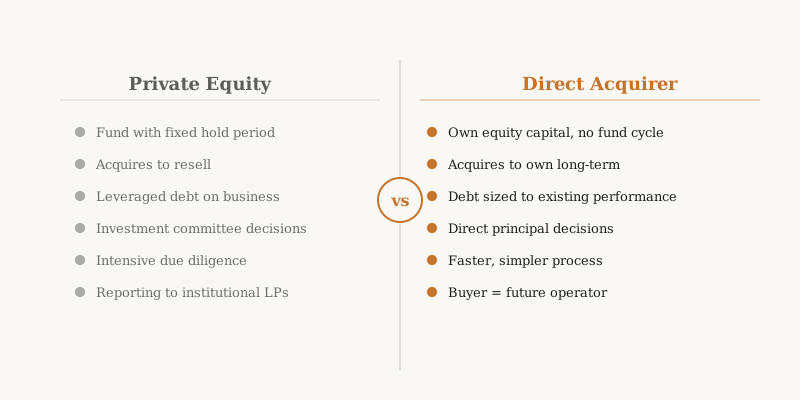
Private equity firms buy a business to sell it again, usually within three to seven years, funding the deal partly with debt secured against the business itself so the fund can hit the returns it owes its investors. A direct acquirer buys a business to own and run it indefinitely, using its own capital and sizing any debt to what the business can already afford, not to what an aggressive growth plan might one day support. Business owners exploring a sale often lump both in with brokers, trade buyers, family offices and management buyout teams as simply "buyers," but private equity and a direct acquirer work in almost opposite ways, and confusing the two can lead an owner to choices that do not serve their interests.
When business owners start exploring a sale, they quickly encounter a landscape that is more varied than they expected. Brokers, trade buyers, private equity firms, family offices, management buyout teams, and direct acquirers — all of them described as “buyers,” all of them approaching transactions differently. Of all the distinctions worth understanding, the one that causes the most confusion is the difference between private equity and a direct acquirer. The two are fundamentally different in how they work, what they are trying to achieve, and what the experience of selling to them looks like. Getting this wrong can lead owners to make choices that do not serve their interests. What Private Equity Actually Does Private equity firms raise funds from institutional investors — pension funds, sovereign wealth funds, endowments — and deploy that capital into business acquisitions. They hold their investments for a defined period — typically three to seven years — and then sell, returning capital and profit to their investors. This structure has several important implications for anyone selling to a PE firm. The hold period is finite and the exit is planned from the start. When a PE firm acquires your business, they are simultaneously thinking about who they will sell it to in five years. The acquisition strategy, the operational decisions, and the financial engineering are all oriented towards making the business attractive to the next buyer. Your business is an investment asset in a portfolio. The returns that the fund needs to generate for its investors drive every significant decision. PE typically uses leverage. Most PE acquisitions are funded partly with equity and partly with debt — often significant amounts of debt secured against the business itself. This is called a leveraged buyout (LBO). The debt repayment obligation is placed on the acquired business, which means the business is operating with a financial burden it did not have under your ownership. In good conditions, this accelerates growth. Under stress, it can be destructive. PE firms have investors they are accountable to. Decisions are not made by an individual who owns the capital — they go through investment committees, require reporting to limited partners, and are subject to governance structures that can slow things down and create obligations that affect how the business is run. None of this makes private equity bad. For the right business and the right owner, PE can be an excellent outcome — they bring capital, operational resource, and often genuine expertise in scaling businesses. But it is important to go in understanding what you are part of. What a Direct Acquirer Does A direct acquirer buys businesses to own them — not to package them for resale, not to hold for a fund cycle, and not to service a leveraged capital structure. The acquisition is funded with equity capital, and the intention is long-term ownership and operation. This changes the nature of the transaction in several ways. The buyer’s motivation is the ongoing health of the business, not its next exit. A direct acquirer who pays a fair price for a business and then grows it generates a return through the business’s own performance. There is no countdown clock to a forced exit. There is no pressure to grow EBITDA by 40% in three years to make an LBO work. The decisions made post-acquisition are made with the long-term best interests of the business in mind. Debt sized to what the business can already support. Like most acquisitions, a direct acquirer may use debt as part of the funding structure — but the critical difference is how that debt is sized. A PE-backed leveraged buyout is typically structured to maximise the debt load the business can theoretically service under an aggressive growth scenario. A responsible direct acquirer sizes any debt to what the business can comfortably service based on its existing performance, before any growth is added. The business is not put under financial pressure from day one to make the acquisition economics work. Faster decisions. Without an investment committee, without a fund structure, and without the governance requirements of institutional capital, a direct acquirer can make and execute decisions quickly. Initial conversations, offers, and completions move at a pace that reflects the principals making their own choices rather than navigating institutional processes. The owner is dealing with the actual buyer. In a PE process, the people you meet during the sale — the dealmakers, the partners — are not the people who will own and run the business. Their job is to acquire it. Post-completion, the business will be managed by a portfolio operations team, potentially a new CEO brought in by the fund, and monitored through financial reporting rather than daily involvement. With a direct acquirer, the person buying is typically the person who will be responsible for the business afterwards. What to Think About When Choosing If you are a business owner evaluating different types of buyers, the right question is not “which type is better?” — it is “which type fits what I actually want from the exit?” If your priority is the highest possible price and you are comfortable with a complex process, extensive due diligence, and an intensive growth programme under new ownership, PE may be the right environment. If your business is at a scale and stage that is attractive to institutional capital, and you have the kind of management team that PE firms like to back, it is worth running a proper process. If your priorities are speed, certainty, confidentiality, protecting your team and culture, and dealing with a buyer who is acquiring to own rather than to sell, a direct acquirer is likely the better fit. The process will be simpler, the decision-making faster, and the post-completion relationship more straightforward. The distinction matters most for owners who have assumptions about what the sale will feel like that do not match the reality of the buyer they are speaking to. Sellers who imagine a private equity process will feel like a straightforward business sale, and then find themselves inside an intensive six-month due diligence with a team of advisers, often find the experience unsettling. Conversely, owners who expect the institutional rigour of a PE process from a direct acquirer sometimes find the speed and directness unfamiliar. Where Oceanus Group Sits We are not a private equity firm. We do not raise funds from institutional investors, we do not operate on a defined hold period, and we do not answer to a fund’s return requirements. We buy businesses to own, operate, and grow them — with our own capital, at our own pace, with our own long-term agenda. Where we use debt as part of an acquisition structure, we size it to what the business can already comfortably service — not to what an aggressive growth plan might one day support. The business should not have to outperform just to stay solvent under its new ownership. That is a principle we hold to. That means no investment committee between you and a decision. No fund cycle forcing an artificial timeline. No punishing debt load dropped onto the business at completion. And a process that is as straightforward as a transaction of this significance can be. If that distinction matters to you, let’s talk . Ready to explore your options? We're direct acquirers — no broker fees, total confidentiality, and no obligation to proceed. Start a Confidential ConversationReady to explore your options?
We're direct acquirers — no broker fees, total confidentiality, and no obligation to proceed.
Start a Confidential Conversation