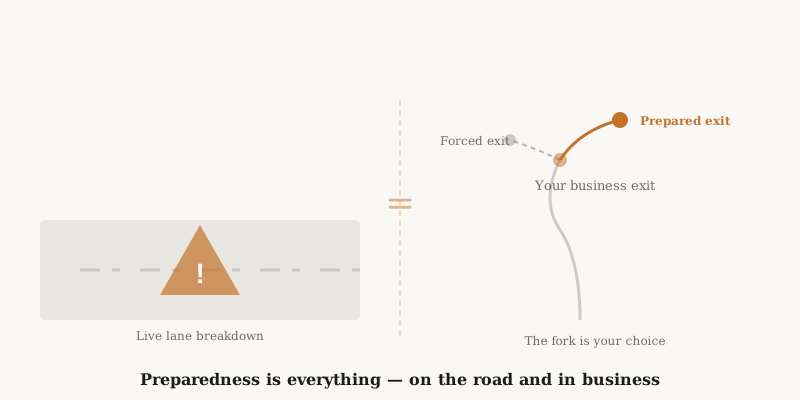
Breaking down in a live lane on a 70mph road during rush hour feels remarkably like facing a forced exit from your business: both strip away your sense of control and leave you needing calm, informed help fast. I found this out first hand recently, when my car failed in live traffic during rush hour; the police blocked the lane and the AA got me to safety, but the fear and powerlessness stayed with me. It's not something I recommend.
Afterwards, it struck me how closely that experience mirrors what business owners describe when they're considering, or being forced into, an exit from their business.
Recently, I had the unfortunate experience of breaking down in a live lane on a 70mph road during rush hour. It’s not something I recommend. It was as frightening as it sounds — vehicles passing at speed, no clear path to safety, and a growing sense that the situation was completely out of my hands. Everything was eventually dealt with safely after the police blocked the lane and the AA came to the rescue. But afterwards, it got me thinking about how closely that experience mirrors what business owners describe when they’re considering — or being forced into — an exit from their business. The Feeling of Powerlessness When your car breaks down unexpectedly on a busy road, the adrenaline is immediate. You feel urgency, but there’s no clear path forward. Frustration sets in. You want to act but don’t know what action to take. For many business owners contemplating an exit — whether planned or forced by circumstances — the emotional experience is remarkably similar. Questions swirl: Should I sell now or wait? Can I find a buyer? What happens to my staff? What if I can’t get a fair price? What if I’ve left it too late? Both situations create a conflict between instinct and rational thought. On the road, instinct says jump out and flag someone down. In business, instinct might say push on, double down, or look away entirely. In both cases, instinct without a plan rarely produces a good outcome. Finding Direction in Calmness When you break down, the first practical step — putting your hazard lights on — seems almost trivially small given the scale of the problem. But it’s crucial. It signals your situation, buys you time, and starts the process of getting help. For a business owner facing an exit, the equivalent is reaching out: to a mentor, an advisor, an experienced acquirer, or simply someone who has been through the process before. Creating a support network early provides a lifeline when the pressure is greatest. Just as a motorist needs to assess the situation and remain composed before deciding what to do next, business owners must try to evaluate their options rationally rather than reactively. Taking a breath, identifying what resources are available, and outlining the realistic paths forward is almost always more productive than panicking. The Importance of a Well-Prepared Exit Strategy One of the most unsettling feelings during a breakdown is the sense that it might have been preventable — with better maintenance, with a little more attention to warning signs that had been building for a while. Businesses are similar. The owners who navigate exits most successfully are rarely those who started planning the week they decided to sell. They are the ones who had been thinking about their exit for years — keeping clean accounts, building a business that could operate without them, maintaining clear records, and developing relationships with people who might one day be in a position to buy. A well-prepared exit strategy transforms the process from a sudden, reactive crisis into a guided journey. Knowing your options — whether it’s a trade sale, a management buyout, a partial sale, or winding down — means you can approach the situation with intention rather than desperation. Understanding why so many business owners struggle to sell is a useful starting point. Embracing Change Both situations — the breakdown and the business exit — require accepting that change is happening, whether you invited it or not. Resisting that reality, or delaying action in the hope that things will resolve themselves, rarely helps. Just as drivers must adjust to the conditions on the road — unexpected delays, detours, decisions made at speed — business owners must adapt to financial pressures, shifting markets, and personal circumstances. Accepting that both journeys involve unexpected challenges is part of navigating them successfully. Conclusion Breaking down in a live lane and facing a business exit are very different situations. But the emotions they generate — powerlessness, uncertainty, the desperate need for direction and support — have a great deal in common. The lesson from both is the same: preparedness matters enormously, calm decision-making outperforms panic, and having the right people around you makes the difference between a good outcome and a very difficult one. If you’re at a point in your business journey where you can see the road ahead narrowing — or if you simply want to understand your options before the pressure arrives — get in touch for a confidential conversation . You can also read more about how our acquisition process works . Ready to explore your options? We're direct acquirers — no broker fees, total confidentiality, and no obligation to proceed. Start a Confidential ConversationReady to explore your options?
We're direct acquirers — no broker fees, total confidentiality, and no obligation to proceed.
Start a Confidential Conversation