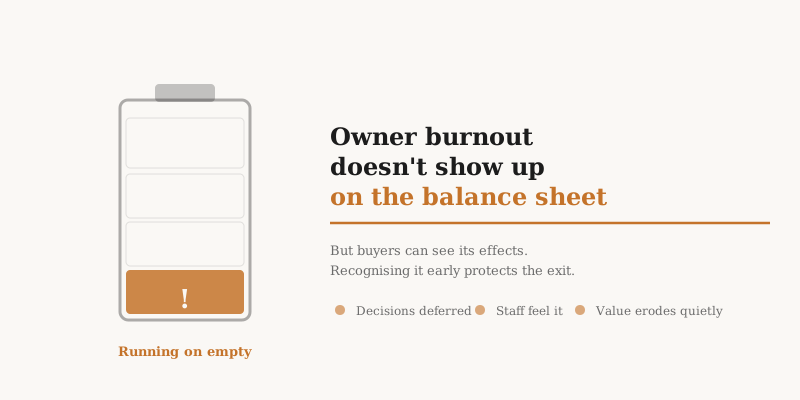
Burnout is a business risk because it quietly erodes the decisions, relationships and value that keep a business performing, long before the accounts show any problem. Left unchecked, it can turn a business worth £3 million into one worth £2 million within a couple of years, and it often pushes owners toward selling from a position of weakness rather than strength.
There is a particular kind of exhaustion that business owners know well. It is not the tiredness of a hard week or a demanding project, but something deeper: the feeling that the business that once energised you has become a weight you are carrying rather than a vehicle you are driving. The irony is that many of the owners who feel this most acutely are among the most successful. They built something real, made payroll when the bank balance was frightening, and held on through years when walking away would have been easier. Somewhere in that process, the energy that sustained it all ran down.
There is a particular kind of exhaustion that business owners know well. It is not the tiredness that comes from a hard week or a demanding project. It is the deeper, more pervasive kind — the feeling that the business that once energised you has become a weight you are carrying rather than a vehicle you are driving. The irony is that many of the business owners who feel this most acutely are among the most successful. They built something real. They kept it going through difficult periods. They made payroll when the bank balance was frightening, held on through the years when walking away would have been easier. And somewhere in the process, the energy that sustained all of that ran down. Burnout in business owners is more common than the industry acknowledges. It is also, paradoxically, one of the worst positions from which to make decisions about the future of the business. How Burnout Shows Up in a Business Owner burnout does not announce itself cleanly. It tends to present as a series of small changes that individually seem unremarkable but, taken together, signal something significant. Decisions that used to be made quickly get deferred. Growth initiatives that would once have been pursued are left on the table because the energy required to execute them is not there. Staff management — never anyone’s favourite part of running a business — becomes harder. Customer relationships that the owner once tended carefully get less attention. The business begins to drift rather than drive. From the outside, looking at the accounts, none of this is immediately visible. Revenue is stable. Costs are under control. On paper, the business looks fine. But the owner, who is inside it every day, can feel the deceleration — and often does not know what to do about it. The danger is that this state can persist for years. The owner is too tired to change it but not in enough immediate crisis to force a decision. The business continues to operate, but at a level below its potential — and the gap between what it is and what it could be widens gradually. Why It Matters for the Business Owner energy is a resource that the business depends on, whether or not it shows up on the balance sheet. When it depletes, the consequences are concrete. Staff are highly sensitive to the emotional state of the leadership. An owner who is disengaged, irritable, or visibly ground down creates an environment in which the best staff — the ones with options — start to look elsewhere. The subsequent turnover compounds the problem, because the owner now has to manage the upheaval of losing key people on top of everything else. Customer relationships that depend on the owner’s personal involvement — which, in a Stage One or Stage Two business, is most of them — receive less attention. Small irritations that a fully engaged owner would have caught and resolved become larger problems. Strategic decisions do not get made. The business continues running on its existing momentum rather than being actively steered. In a stable environment that can work for a while. In a changing market, it is dangerous. Burnout as an Exit Signal There is nothing shameful about recognising that you are done. Building and running a business for ten or twenty years is an extraordinary effort. The founder who reaches a point where they want to pass the business on to someone who has the energy and the fresh perspective to take it further is not failing — they are making a responsible decision, both for themselves and for the business. The problem is that many owners, by the time they acknowledge the burnout, have already allowed it to affect the business in ways that complicate the exit. Revenue has slipped. Key staff have left. The management team, never fully developed, has been further undermined by the period of owner disengagement. The business that would have been worth £3 million two years ago is now worth £2 million — and the process of selling it from this position is harder than it needed to be. This is why the recognition matters — and why it matters early. An owner who identifies the depletion at its early stages has choices. They can make the decision to exit from a position of reasonable strength: the business is still performing, the team is still intact, the financial record is still clean. They can run a proper process, engage with serious buyers, and achieve a price that reflects the business at its best. An owner who pushes through burnout until the business is visibly suffering has far fewer options. The buyers who are willing to acquire a business that is showing signs of owner-driven decline will price that risk in aggressively. The exit that could have been clean and financially sound becomes something harder and more painful. What to Do If You Recognise This First: name it. Many business owners go a long time without acknowledging to themselves what is actually happening. The acknowledgement is not a defeat — it is the beginning of making a rational decision. Second: get an honest picture of where the business actually is. Not the version in your head, but the version a buyer would see. If the business is still performing well, you have more options than you might feel you do. Third: understand what those options are. Selling is not the only path — though it is often the most financially rational one. Some owners in this position bring in a managing director and step back into a more strategic role, preserving their equity while removing the daily operational burden. Some complete a partial sale, taking some liquidity while retaining involvement. Some do decide to exit fully and find that the relief is enormous. The one thing that is consistently true is that the earlier the conversation starts — with a trusted adviser, with a potential buyer, with someone who has navigated this territory before — the better the outcome tends to be. We have spoken with enough owners in exactly this situation to know that it is more common than anyone admits, that it is manageable, and that the path through it is usually clearer than it feels from inside it. Get in touch — the conversation is confidential, there is no obligation, and sometimes just talking through the options with someone who has seen it many times before is what is needed most. Ready to explore your options? We're direct acquirers — no broker fees, total confidentiality, and no obligation to proceed. Start a Confidential ConversationReady to explore your options?
We're direct acquirers — no broker fees, total confidentiality, and no obligation to proceed.
Start a Confidential Conversation