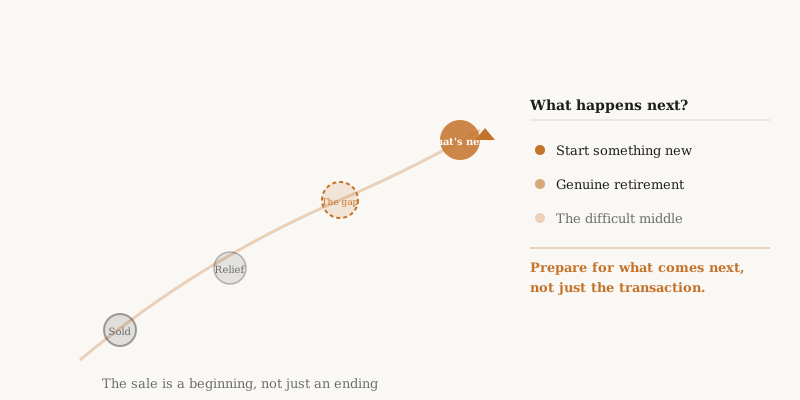
Most business owners fall into one of three patterns after they sell: some start something new, becoming founders again, angel investors or non-executive directors; some genuinely step back into retirement, travel and family life; and a smaller group struggle, finding six months after completion that the loss of daily structure, social contact and purpose is harder to handle than they expected. The transition reshapes virtually everything, including — as we have written about in more depth in our piece on the founder's identity problem — the sense of who they are.
There is a conversation that almost never happens in the run-up to a business sale. Advisers focus on structure, price, and process. Accountants focus on the tax position. Lawyers focus on warranties and indemnities. And the owner, swept along in the current of the transaction, focuses on getting to the finish line. The question of what comes after — what the owner actually does on the Monday morning following completion — is left largely unexamined. This matters more than the industry acknowledges. The transition out of business ownership is one of the most significant life changes a person can make. For founders who have run a business for ten, twenty, or thirty years, it reshapes virtually everything: daily structure, social relationships, sense of purpose, financial management, and — as we have written about in more depth in our piece on the founder’s identity problem — the sense of who they are. What the Research Says Studies of business owners who have sold their companies consistently find that the financial outcome is rarely the thing they talk about most in the years afterwards. The things they talk about most are the loss of structure, the loss of social contact, and — particularly for those who did not plan carefully — a sense of purposelessness that arrives several months after the sale, once the relief of completing the transaction has faded. This is not universally true. Many former business owners describe their post-sale years as the most satisfying of their lives. But the ones who do almost uniformly had one thing in common: they had thought seriously about what they were moving towards, not just what they were moving away from. The Patterns That Emerge When you speak to enough former business owners, several patterns emerge around what people actually do after selling. Some go straight into something new. Former owners who are energetic, entrepreneurial, and relatively young at exit often find that the desire to build something does not diminish. They start a new business — sometimes in the same sector, sometimes entirely different. They become angel investors and get involved in early-stage companies that need the operational experience they spent decades accumulating. They take non-executive roles in businesses where their specific expertise is valuable. For these people, the challenge of the post-sale period is not finding purpose — it is channelling their energy appropriately and resisting the temptation to replicate exactly what they just sold. Some genuinely step back. A significant proportion of business owners, particularly those who sold later in their career, find that the transition to retirement is exactly what they wanted. Travel, family time, hobbies that were neglected for years — these fill the space, and fill it well. The key for this group is having adequate preparation: financial, practical, and psychological. Some struggle. This is the group that nobody talks about. Former owners who did not plan the post-sale chapter, who had no clear sense of what they were going to do, and who discover — six months after completion, once the distraction of the transaction is over — that the loss of structure and purpose is harder to handle than they expected. Some experience genuine difficulty: anxiety, a sense of irrelevance, fraying social relationships that were built around the business rather than independent of it. This group is not made up of people who made bad decisions. They are often the people who were most focused on the business during the exit process — understandably — and left least time to think about what came next. The Preparation That Makes the Difference The common factor in successful post-sale transitions is preparation — started before, not after, the sale completes. Financial clarity. Most business owners are not experienced at managing large pools of capital. The proceeds of a business sale are often the largest sum of money they have ever had to manage. Taking proper financial advice — ideally from someone who specialises in advising former business owners — before completion means the financial structure is in place from day one. Tax planning, investment strategy, and income requirements all need to be understood in advance. Structure. The business provided a daily structure that is easy to underestimate when you have it and hard to replace when you do not. Former owners who fare best after a sale typically have a sense, in advance, of what their week will look like. Not a rigid schedule — they have usually had enough of those — but a shape. Meetings, commitments, projects, and activities that give the day a purpose and rhythm. Social relationships. Business ownership provides an unusually rich social environment: staff, customers, suppliers, advisers, peers in the sector. Some of those relationships will continue naturally. Others are entirely transactional and will end with the business. Owners who have invested in relationships outside the business — family, friends, community — have a much fuller social life to return to. Those who have not sometimes find the social landscape surprisingly empty. The “next thing.” This does not need to be a new business or a packed schedule. For some owners it is a cause, a craft, a place, or simply more time with people they love. But having some sense of what it is — even broadly — before the sale completes makes the transition dramatically smoother than arriving at completion with no plan and expecting the answer to appear. A Final Thought The sale of a business is an ending. But the owners who plan most carefully for what happens next tend to experience it as a beginning. The financial outcome matters — of course it does. But the quality of the post-sale years depends far more on the quality of the preparation for them than on the number at the bottom of the completion statement. If you are thinking about selling and want to talk through not just the transaction but what comes after, we are worth talking to . We have had these conversations with enough former owners to understand that it is often the most important part of the whole process. Ready to explore your options? We're direct acquirers — no broker fees, total confidentiality, and no obligation to proceed. Start a Confidential ConversationReady to explore your options?
We're direct acquirers — no broker fees, total confidentiality, and no obligation to proceed.
Start a Confidential Conversation