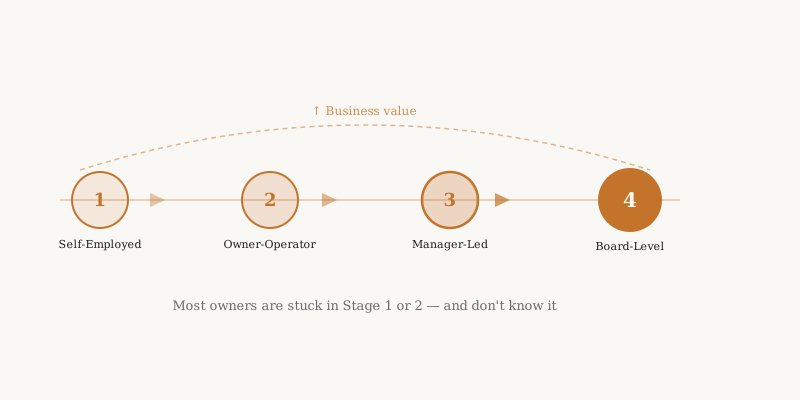
The four stages of business ownership are Operator, Manager, Director and Chairman, and which one your business sits at will decide the multiple you achieve, the buyer you attract, the deal structure on offer, and how long you are tied in after completion.
There is a thirty second test to find out where you stand. If you disappeared for six months, with no calls, no emails and no availability, would the business collapse (Stage One), survive but not thrive (Stage Two), or run perfectly well (Stage Three or Four)? The honest answer tells you more about your exit prospects than most valuations will.
There is a test you can apply to your business right now. It takes thirty seconds and the answer will tell you more about your exit prospects than most valuations will. The test: if you disappeared for six months — no calls, no emails, no availability — what would happen to the business? If the honest answer is “it would probably collapse,” you are at Stage One. If it would survive but not thrive, Stage Two. If it would run perfectly well, Stage Three or Four. Where you sit in this framework shapes almost everything about your eventual exit: the multiple you will achieve, the buyer you will attract, the deal structure on offer, and how long the transition will take. Stage One: The Operator At Stage One, you are the business. Revenue flows through your relationships. Decisions flow through your desk. The operation depends on your daily presence in a way that makes it, from a buyer’s perspective, not quite a business at all — it is a job that happens to have some employees attached. This is not a criticism. Most businesses start here. The founder builds something out of nothing through personal effort, expertise, and reputation. That is admirable. But it creates a structural problem: a buyer is not paying for your personal reputation, your client relationships, or your technical expertise. When you leave, those things leave with you. The brutal commercial reality of Stage One is that the business is worth roughly what its tangible assets plus a small multiple of its transferable earnings are — and “transferable” is the operative word. Revenue that disappears when the owner leaves is not, in a buyer’s eyes, worth paying for. If you are at Stage One and thinking about selling, you have two options. Accept a lower price to reflect the risk a buyer is taking on, or invest the time to move the business to Stage Two or Three before going to market. Stage Two: The Manager At Stage Two, you have a team. Some decisions are delegated. Some processes are documented. The business would survive your absence — for a while, anyway — but it would feel your absence acutely. Key staff would be pulling in different directions without your hand on the wheel, and some client relationships would drift. Most owner-managed SMEs sit somewhere in Stage Two for most of their lives. The owner has hired good people, stepped back from the day-to-day production work, and taken on a more managerial role — but still makes most significant decisions, still holds the most important client relationships, and is still, in the minds of staff and customers, the business. A Stage Two business is genuinely sellable, particularly to the right buyer. A trade buyer who brings their own management, an acquirer willing to retain the owner through a transition period, or an investor who sees the growth potential rather than the current dependency — these buyers exist, and they buy Stage Two businesses regularly. The deal structure, however, will typically reflect the risk. Earn-outs are more common at Stage Two. Retention periods are longer. The price will be adjusted to account for the possibility that some revenue walks out with the owner. Stage Three: The Director At Stage Three, you have a management team that runs the business operationally. You are involved strategically — you set direction, approve significant decisions, and stay close to performance — but you are not required for the day-to-day. The business works without your physical presence. This is where the business starts to look, to a buyer, like a genuinely standalone asset. There are people in place who know how to run it. Processes are documented. The revenue base is not dependent on one individual. A buyer can acquire the business and its management capability simultaneously. The shift from Stage Two to Stage Three is often the most valuable leverage a business owner can create in the years before selling. A business at Stage Three will typically attract a higher multiple than the same business at Stage Two, simply because the buyer’s risk is lower and the post-completion transition is cleaner. Getting to Stage Three requires deliberate investment in people and process — usually two to five years of conscious effort to build a leadership layer that doesn’t depend on the founder for its authority. The financial return on that investment, when the business eventually sells, is almost always worth it. Stage Four: The Chairman At Stage Four, you attend board meetings. You review financials. You weigh in on major strategic decisions. But the business has a CEO, or a managing director, or a senior leadership team that runs the operation without your regular involvement. This is the end state that commands premium valuations and the cleanest possible exits. A buyer acquiring a Stage Four business is acquiring a functioning organisation with its own momentum. The transition from old owner to new is largely logistical rather than operational. Customers deal with the management team, not the founder. Staff loyalty is to the business, not to the individual. Stage Four is not the reality for most SMEs — it requires a level of organisational development that takes time and usually requires significant revenue to fund a proper management layer. But it is the target. And even moving from Stage Two to Stage Three creates enormous value. What This Means for Your Exit The honest conversation that very few advisers have with business owners is this: the stage your business is at when you go to market will determine your exit more than almost anything else. Not the turnover. Not the profit margin. Not the sector. The structural question of how dependent the business is on you personally is the single biggest variable in what a buyer will pay and how easy the sale will be. The good news is that this is a solvable problem. Unlike market conditions or sector trends, it is within your control. The less good news is that it takes time — moving meaningfully between stages typically takes two to four years of deliberate effort. Which is why starting your exit planning early matters so much. If you are not sure which stage your business is at — or what it would take to get to the next one — that is exactly the kind of conversation we have with owners at every stage. Get in touch and we can give you an honest view of where you are and what your options look like from here. Ready to explore your options? We're direct acquirers — no broker fees, total confidentiality, and no obligation to proceed. Start a Confidential ConversationReady to explore your options?
We're direct acquirers — no broker fees, total confidentiality, and no obligation to proceed.
Start a Confidential Conversation