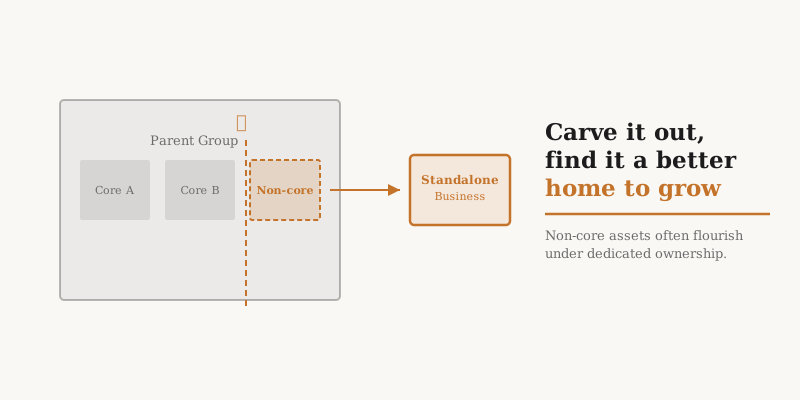
Selling a non-core business unit means separating it from the wider group before it can go to market. These deals — usually called carve-outs or divestments — involve disentangling the unit from shared finance, HR, IT, legal and premises arrangements, and giving buyers clarity on TUPE-protected employees, intercompany trading relationships, and a standalone valuation at completion.
If you are a group executive, finance director, or CEO responsible for divesting a business unit, this guide is written for you.
Not every business sale begins with a founder who has spent thirty years building something from scratch. A significant and growing proportion of acquisitions involve something different: a corporate group that has decided to exit a business unit, a subsidiary, or a division that no longer fits its strategy. These transactions — often called carve-outs or divestments — follow the same broad arc as any business sale. But the details, the complications, and the considerations are quite different. If you are a group executive, finance director, or CEO responsible for divesting a business unit, this guide is written for you. Why Corporates Divest The decision to sell a business unit rarely reflects poorly on the unit itself. In most cases, the business being divested is viable and often profitable. The reason for the sale is strategic: the unit no longer fits the group’s focus, capital is better deployed elsewhere, the unit needs investment that the group does not want to commit, or the board has decided to concentrate on a narrower set of activities. Private equity activity has added another driver: portfolio rationalisation. Groups that were assembled through acquisition — particularly those with PE involvement in their history — often contain businesses that were acquired for strategic reasons that have since changed. Whatever the motivation, the starting point for a successful carve-out is the same: clarity about what is being sold, and separation of the business from the group infrastructure it shares. The Separation Problem This is the central challenge of a corporate carve-out and the one that most distinguishes it from a straightforward founder exit. A business unit embedded in a larger group typically shares infrastructure with its siblings: finance and accounting functions, HR, IT systems, legal support, premises, insurance policies, branding, and often supply and customer relationships that cross entity boundaries. Some of these shared services will have been allocated to the unit on a cost basis; others will simply have been absorbed into the group without explicit tracking. A buyer acquiring the unit needs to understand — and be comfortable with — what happens to all of those shared services at completion. Can the unit operate independently from day one? What will it need to replicate or replace that it currently gets from the group? What is the realistic cost of standing up a standalone finance function, or of migrating to its own IT systems? The answers to these questions affect both the attractiveness of the business to a buyer and the price they will pay. A business unit that is genuinely self-contained is much easier to sell than one that requires eighteen months of separation work before it can function independently. The practical implication: the earlier a corporate starts the separation process — even notionally, on paper — the better positioned the eventual sale will be. TUPE and Employment Considerations Employee transfer regulations (TUPE — the Transfer of Undertakings (Protection of Employment) Regulations) apply to business sales in the UK and impose obligations on both the selling and acquiring parties. In a carve-out context, the picture is complicated by the fact that some employees may work partially or wholly across multiple entities. Buyers will want clarity — with legal backing — on which employees transfer, on what terms, and with what liability for historic employment matters. Group HR functions that have handled matters across multiple entities may have created records or made commitments that affect the transferring employees in ways that are not immediately obvious. This is an area where experienced legal advice is essential, and where early engagement — before the sale process formally begins — significantly reduces the risk of complications late in the day. Intercompany Agreements and Trading Relationships Many carve-out situations involve ongoing trading relationships between the unit being sold and the wider group. The unit may supply the group, buy from it, share premises, or rely on group-level contracts with suppliers or customers. A buyer will need to understand exactly what those relationships are and what happens to each of them at completion. Intercompany contracts that were never formally documented — which is common within groups where the legal formalities of internal trading arrangements were not prioritised — need to be made explicit before a sale process begins. More complex are the customer and supplier relationships that sit at the group level but partially serve the unit being sold. Where a key customer contract is held by the parent, the unit’s claim on that revenue may not automatically transfer. Where a supplier agreement at group level gives the unit access to preferential pricing, the unit will need to renegotiate its own terms after separation. These issues are manageable. But they need to be identified and addressed — not left to surface during a buyer’s due diligence. Valuation in a Carve-Out Valuing a business unit is more complex than valuing a standalone business because the unit’s reported financials typically reflect cost allocations, intercompany pricing, and shared overhead arrangements that will not survive in their current form post-sale. A buyer will want to understand the “true” economics of the business as if it were standalone — what revenues would it have generated independently, what costs would it have incurred, and what profit would it have made? This involves stripping out group cost allocations, adjusting for any non-commercial intercompany pricing, and estimating the cost of services currently provided by the group that the unit will need to replicate. This exercise — sometimes called “carve-out financials” or a “standalone earnings” analysis — is typically prepared by the selling group and then verified by the buyer during due diligence. The more rigorously it is prepared and the more conservative the assumptions, the more credibly it will hold up under scrutiny. Finding the Right Buyer Corporate carve-outs attract a different buyer profile from most SME sales. Because the businesses involved are often larger, more complex, and more capital-intensive, the buyer pool tends towards private equity, trade buyers with strategic interest in the sector, and experienced acquisition vehicles. What all of these buyers share is a need for a clear and credible information pack — a clean set of carve-out financials, a transparent account of the separation requirements, and a realistic picture of the business as a standalone entity. Groups that invest in preparing this material attract better buyers at better prices than those that go to market with the intention of disclosing complexity as it is discovered. At Oceanus Group, we acquire both founder-led businesses and non-core divisions from larger groups. The approach is direct — no broker in the middle — and the conversation begins with exactly the kind of honest assessment of what is being sold and what the separation requirements are. If you are a corporate considering the divestment of a business unit and want to understand what that process looks like from a buyer’s perspective, get in touch . It is a conversation worth having early. Ready to explore your options? We're direct acquirers — no broker fees, total confidentiality, and no obligation to proceed. Start a Confidential ConversationReady to explore your options?
We're direct acquirers — no broker fees, total confidentiality, and no obligation to proceed.
Start a Confidential Conversation