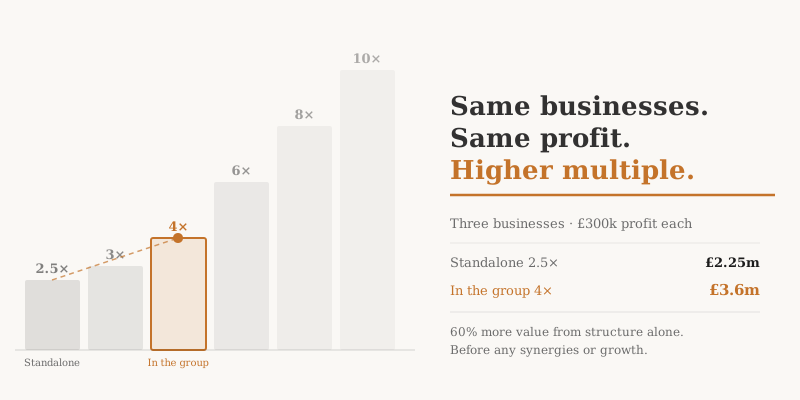
Group building unlocks higher exit values by combining several small businesses into one group, so their combined turnover crosses into a higher pricing tier than any of them could reach alone. Three businesses each generating £500,000 profit and £2.5 million turnover would sell for £1.25 million apiece on their own, at a 2.5x multiple; combined, the group's £7.5 million turnover and £1.5 million profit price at 4x, making the group worth £6 million - each owner's stake rising from £1.25 million to roughly £2 million, without changing the underlying businesses.
The reason is a structural bias baked into how businesses are valued: buyers pay more, per pound of profit, for larger businesses than smaller ones, simply because they are larger, more resilient, and more attractive to a wider pool of institutional buyers.
Group building does not change your business. It changes your position in the market.
Why Do Small Businesses Sell for a Lower Multiple?
When a buyer assesses a business, they apply a multiple to its earnings. That multiple reflects how attractive the business is as an investment — how stable its income, how replaceable its people, how likely it is to keep performing after the owner leaves.
Small businesses get lower multiples for several reasons. They tend to be owner-dependent. Their customer base is often narrower. They have less management depth. And most importantly, they are too small to attract institutional buyers — the private equity firms, listed corporates, and acquisition vehicles that have both the capital and the appetite to pay a premium.
The result is a multiple tier system that works against small business owners at the worst possible time.
The EBITDA Multiple Staircase
Here is how the market typically prices businesses by size in the UK:
| Combined Group Turnover | Indicative EBITDA Multiple |
|---|---|
| Under £2.5m | 2.5× |
| £2.5m – £5m | 3× |
| £5m – £10m | 4× |
| £10m – £15m | 6× |
| £15m – £25m | 8× |
| £25m+ | 10× |
These are not arbitrary numbers. They reflect the depth of the buyer market at each tier. Above £25 million turnover, you attract serious institutional interest and the price competition that comes with it. Below £2.5 million, you are largely selling to individual investors and small trade buyers — a much thinner, more uncertain market.
The step from 2.5× to 10× is not a small jump. On £500,000 of profit, that is the difference between a £1.25 million exit and a £5 million exit. For the same business, the same profit, the same team.
The only thing that changed was scale.
What Is Group Building?
Group building is the process of combining several smaller businesses into a single group entity — not a merger, not an acquisition in the traditional sense, but a structured combination that makes the sum worth substantially more than its parts.
At Oceanus Group, we work with owners of profitable UK businesses to form these groups collaboratively. Each owner joins at a fair entry value based on their business’s individual performance. The group is structured properly, with clear shareholdings and transparent governance. And because the group’s combined turnover places it in a higher multiple tier, every owner’s stake is worth more than their business was worth standing alone.
The mechanics are straightforward. The outcomes are significant.
How Are Ownership Shares Calculated in a Group?
One of the first questions owners ask is: how do I know I am being treated fairly?
The answer is that every owner’s share in the group is calculated from their entry value — which is simply their business’s profit multiplied by the standalone multiple it would attract on the open market today. That entry value determines what percentage of the group they hold.
If your business generates £400,000 profit and would sell for 3× standalone, your entry value is £1.2 million. If the other businesses joining the group have a combined entry value of £3.8 million, the total entry value is £5 million — and your share is 24%.
That percentage does not change when the group grows in value. You brought in £1.2 million worth of business. You hold 24% of whatever the group becomes worth.
The arithmetic is transparent. Every owner can see exactly how their share was calculated and verify it against their own numbers.
Part One: The Grouping Effect
The first value uplift happens the moment the group is formed — before any operational changes, before any growth, before any synergies are applied. It happens purely because of scale.
Consider three businesses, each with £500,000 profit and around £2.5 million turnover. Independently, each sells at around 2.5× — a £1.25 million exit each.
Combined, the group has £7.5 million in turnover and £1.5 million in combined profit. At the £5m–£10m tier, the applicable multiple is 4×. The group is now worth £6 million.
Nothing changed about those businesses. No new customers. No new staff. No operational improvements. The owners simply combined, and the group’s position in the market shifted — from the bottom tier to a substantially higher one.
The owner who was facing a £1.25 million exit now holds a stake worth roughly £2 million. That extra £750,000 came from structure, not from working harder.
Part Two: The Synergy Effect
The second wave of value comes from what a well-run group can do that standalone businesses cannot.
When businesses combine, they share infrastructure, reduce duplicated overhead, and cross-sell into each other’s customer bases. A group can invest in shared management, shared technology, and shared marketing in ways that are simply not viable for a £2.5 million turnover business acting alone.
The practical result is that profit margins improve. Turnover grows. And as the group’s financial performance strengthens, it may cross into yet another multiple tier — delivering a further uplift on top of the initial grouping effect.
This second effect compounds the first. Owners who entered the group at a 4× multiple may find their stake is being valued at 6× or 8× by the time the group reaches exit. The share percentages set at the start have not changed. But the value those shares represent has continued to grow.
A Worked Example
To make this concrete: suppose four business owners — each running a business with roughly £300,000 profit and £1.5 million turnover — approach exit independently. At 2.5×, each sells for £750,000. Total value realised across all four: £3 million.
Now suppose those four owners combine into a group. Combined turnover is £6 million, combined profit £1.2 million. At the 4× multiple for this tier, the group is worth £4.8 million — already 60% more than the four businesses would have raised independently.
Apply modest synergy assumptions — say 10% turnover growth and a two-percentage-point margin improvement over three years — and the group’s profit reaches approximately £1.6 million. At the same 4× multiple, that is £6.4 million. At 6×, it is £9.6 million.
Each of the four owners holds roughly equal shares. A stake worth £750,000 on day one may be worth £2.4 million at a 6× exit. From the same business, with the same team, in the same market.
The difference is not effort. It is structure.
Is Group Building Right for Your Business?
Group building works best for profitable, owner-managed businesses with stable turnover, a real customer base, and an owner who is willing to think about exit on a slightly longer timeline in exchange for a substantially better outcome.
It is not for businesses that need rescuing, or for owners who want a quick cash exit tomorrow. The model requires patience — typically a three-to-five year horizon — and a degree of trust in the group structure and the people leading it.
But for owners who have spent years building something genuinely good, and who are frustrated that the market is not prepared to recognise it fairly, group building offers something the traditional exit route does not: a real chance to be valued on the merits of what you built, not just on how big you are today.
The Oceanus Group Approach
We bring businesses together carefully. Every owner we work with enters the group at a fair, verifiable entry value. Shareholdings are transparent and documented. We do not load the group with debt. We do not manage a fund with an external exit mandate. Stephen Hackett leads the process personally — there is no investment committee to satisfy and no pressure to force a sale at the wrong moment.
We are sector-agnostic. If your business has solid fundamentals, a loyal customer base, and a profit of £100,000 or more, we want to hear from you.
The group build model is not complicated. But it does require the right combination of businesses, the right structure, and the right timing. If you are curious whether your business could be part of a group — and what that might mean for your eventual exit — the best starting point is a conversation.
Get in touch — it is confidential, there is no obligation, and we will tell you honestly whether this is likely to be the right path for you.
Ready to explore your options?
We're direct acquirers — no broker fees, total confidentiality, and no obligation to proceed.
Start a Confidential ConversationReady to explore your options?
We're direct acquirers — no broker fees, total confidentiality, and no obligation to proceed.
Start a Confidential Conversation