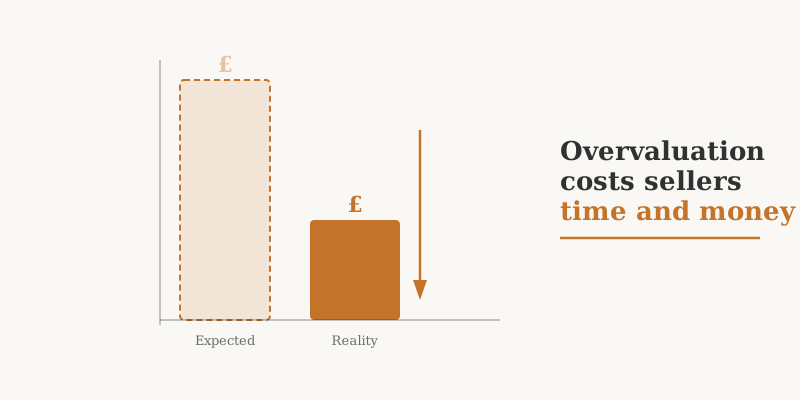
Overvaluing a business when selling almost always backfires: it scares off credible buyers, drags out the sale process for months or years, and typically ends in a lower price than a realistic valuation would have achieved from the start. One seller who priced his business at roughly double its market value lost close to £500,000 after six months with no offers forced a steep price cut; another who overvalued by five times still hadn't sold four years later, by which point the value had fallen further still.
It rarely starts as a deliberate decision. Most sellers overvalue because the business feels worth more than the numbers suggest, after years spent building it - but a buyer is paying for what the business earns, not the journey it took to get there.
Of all the mistakes business owners make when preparing to sell, overvaluation is among the most common — and the most costly. It feels intuitive to value your business highly. You’ve invested years of your life into it. But when the asking price loses touch with what the market will actually pay, the consequences are severe and often irreversible. What Overvaluation Actually Costs You The damage from overvaluing a business isn’t always immediate. The first few weeks on the market may feel fine. But the longer a business sits without credible interest, the harder it becomes to sell — and the lower the eventual price tends to be. Consider two real examples. One seller overvalued his business by roughly double its market value. After six months with no offers and no serious interest, he had to reduce his asking price drastically — ultimately costing him close to £500,000 compared to what he would have achieved with a realistic starting price. Another owner overvalued by five times actual value. Four years later, the business still hadn’t sold — and by that point the value had fallen further still. The pattern is consistent: overvalued businesses take longer to sell, attract lower-quality buyers, and ultimately achieve worse prices than realistically priced businesses. Why Overvaluation Happens Most sellers don’t set out to be unrealistic. Overvaluation typically stems from: Emotional attachment. A business you’ve built from nothing feels worth more than the numbers suggest — because to you, it is. But a buyer is purchasing future cash flows and commercial potential, not your personal journey. Overweighting tangible assets. Equipment, property, and inventory feel concrete and valuable. But these assets don’t automatically translate into business value; what matters to buyers is what the business earns, consistently, and what it’s likely to earn in the future. Benchmarking against outliers. Reading about a competitor selling for an impressive multiple and assuming your business will achieve something similar — without accounting for the differences in size, profitability, sector, or deal structure — leads to unrealistic expectations. Advice from the wrong people. Some brokers inflate valuations at the outset to win a listing. This feels flattering, but it sets the business up to fail. The Impact on Buyers Buyers — particularly experienced ones — identify overvalued businesses quickly. When they do, several things happen: They walk away without making an offer, not wanting to engage in what they expect will be a difficult negotiation. Or they submit a low offer that offends the seller, causing the conversation to collapse. In both cases, an opportunity is lost that may not return. The buyers who do engage with an overvalued business tend to be less experienced or less well-funded — not the credible acquirers who would pay a good price and look after the business properly. HP’s acquisition of Autonomy Corporation in 2011 illustrates what happens when valuation is misrepresented at scale. HP paid $11 billion only to discover the business had been significantly overvalued. The resulting legal action — HP suing Autonomy’s former executives for fraud — became one of the most widely reported corporate scandals in recent history. The lesson applies at every level of the market: valuation misalignment destroys deals and reputations. The Longer-Term Consequences Beyond the immediate deal dynamics, overvaluation creates problems that compound over time: Time on market works against you. A business that has been available for six months, a year, or longer carries a stigma. Buyers ask why it hasn’t sold. They assume there’s something wrong — even when the only issue was the asking price. Your negotiating position weakens. Every price reduction signals that the original ask was unrealistic, which encourages buyers to push further. The longer you hold out, the more leverage shifts to the buyer’s side. The business itself may suffer. Owners managing an extended sales process often take their eye off operations. Revenue dips, staff become unsettled, and customers sense uncertainty. By the time a deal is done, the business being sold is worth less than it was when the process started. How to Value Your Business Realistically A sound business valuation considers multiple factors and perspectives: Profitability and cash flow. Most SME acquisitions are valued on a multiple of EBITDA (earnings before interest, taxes, depreciation, and amortisation) or seller’s discretionary earnings. Understanding what multiple is typical in your sector — usually between 3x and 6x for most SMEs — gives a realistic starting point. Comparable transactions. What have similar businesses in your sector and of your size actually sold for? This information is available from business sale databases and experienced advisers. Growth potential and risks. A buyer pays for the future, not just the past. A business with strong recurring revenue, a diversified customer base, and demonstrated growth will command a higher multiple than one with concentrated risk or declining revenue. Independent professional valuation. A qualified business valuer brings objectivity and market knowledge that neither the seller nor their accountant can provide. Their assessment may be lower than you hoped — but it’s more likely to result in a completed sale. Conclusion Pricing your business realistically isn’t a concession — it’s a strategy. A well-priced business generates competitive interest, which can actually drive the price up through negotiation. An overpriced business generates silence. The sellers who achieve the best outcomes are those who understand the market clearly, take professional advice, and price their businesses to sell — not to satisfy an emotional attachment to what they feel the business should be worth. If you’d like an honest conversation about what your business might realistically achieve in a sale, get in touch with us — there’s no obligation and no broker fees involved. Ready to explore your options? We're direct acquirers — no broker fees, total confidentiality, and no obligation to proceed. Start a Confidential ConversationReady to explore your options?
We're direct acquirers — no broker fees, total confidentiality, and no obligation to proceed.
Start a Confidential Conversation